


Food photography using only natural light
- Charu Shah
- Oct 2, 2018
- 2 min read

This week started with conceptualising the shoot for Sowmiya Venkatesan’s take on Puran Poli. Like all of Sowmiya’s creations this dish was also about stepping outside the lines but retaining the same warm and comfortable feeling.
I will explain below a little more about the light and my camera settings but lets talk about the colours first. To make the yellow and brown Poli pop, I needed it on a dark background. But to many similar coloured elements pose a danger of everything blending into each other and making the image look flat. The black ceramic plate and bowl introduced the right amount of texture and depth into the picture. The light bounced lightly over the rim of the cup and highlighted the blue/black tones of the plate.
A little mulling over Colour Theory goes a long way. The black – green – orange combination is quite close to a triadic colour scheme purple – green – orange. In this case, although black is dominant the accent colours (green and orange) work really well.

I shoot images that are simple, striking and tell a story. I like to spend time in styling and ‘moulding’ light before I shoot, so the resulting pictures do not need much post-processing. A few basic edits are all they need. This specific set up was done in a light box, but without any assistance from studio lights. There was bright afternoon light streaming in from the window. So bright that I had to turn the open side of the light box away from it. A black velvet cloth was stretched out below and behind the plate. That essentially was the entire setup.
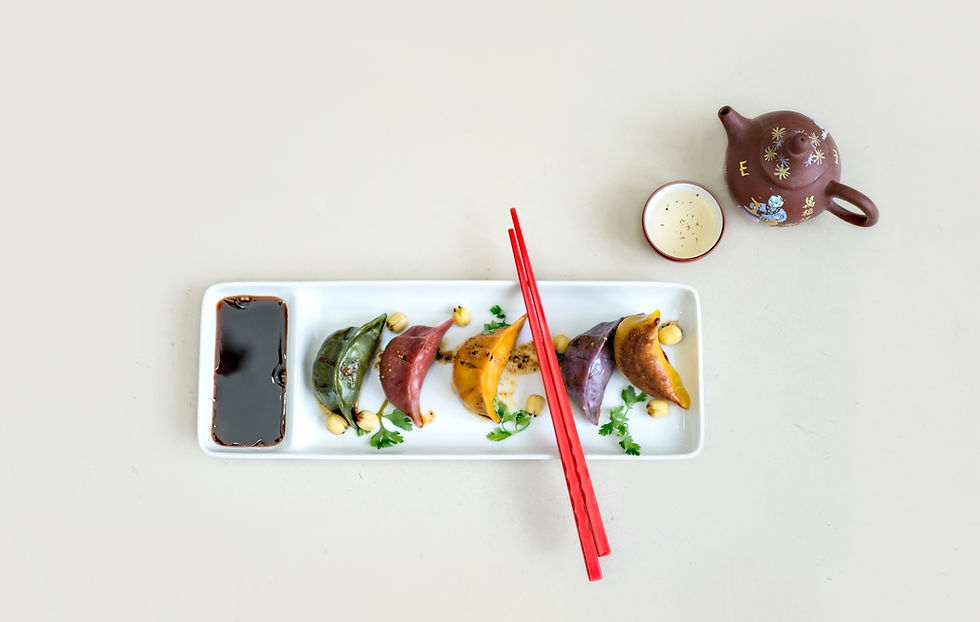
This was the one shoot where there was almost nothing done to the picture except a little clean up, darkening shadows and some sharpening. No filters, no saturation and no digital manipulation. Like in the pictures of the dumplings, my trusted vintage Micro – Nikkor 55mm lens gave me absolute control over the composition and focus. The minimum aperture for this particular lens is f3.5, which is wide enough to keep the sides of the Poli in focus and draw the eye over a lovely soft bokeh.
Here is a comparison of the SOOC images and the final ones. You can see how little was done in post-processing.


The story would be incomplete without the right accompaniment to the dish. Puran Poli is traditionally eaten dunked in ghee. The abundance of the soft afternoon light flowing through the light box is reflected beautifully on the melted Ghee. It highlights the flow from the cup on to the Poli and makes the warm Ghee glisten. Natural light used well is all that’s needed to make even the most humblest of things seem quite spectacular.

For more info get in touch with Charu at charusphoto@gmail.com


Comments