


Food photography the easy way, without studio lights.
- Charu Shah
- Sep 23, 2018
- 3 min read

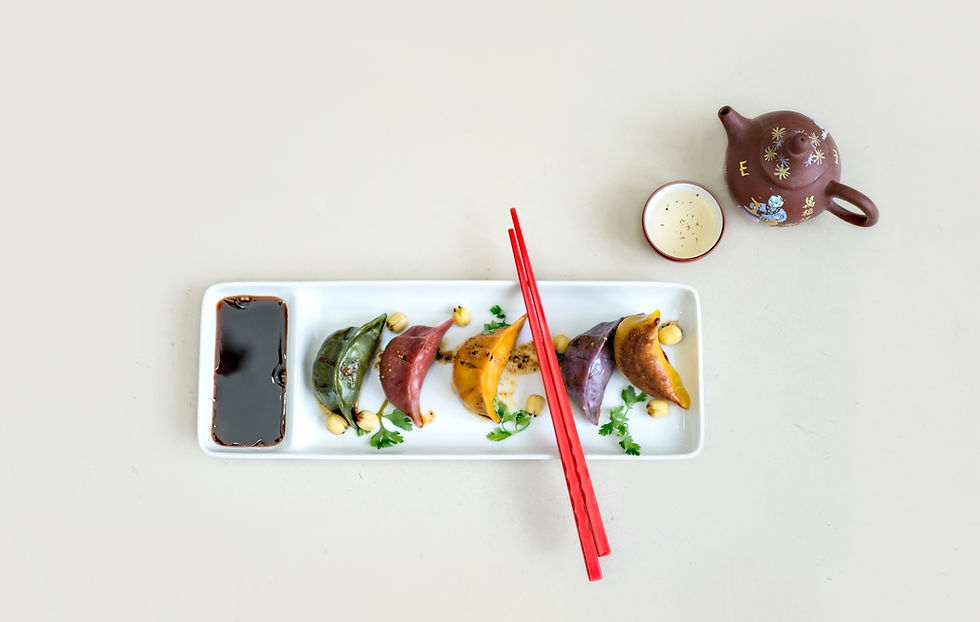
Photographing food or people is not all that different. To me it is all about the light. How I can manipulate it, what the focus of the shot should be and most importantly the story this picture tells.
Sowmiya Venkatesan, a very talented vegetarian food blogger at Kechil Kitchen who is now a MasterChef Singapore contestant. Her dumpling story is about food that is traditional but modern. I was drawn to the idea of showcasing her colourful dumpling on a neutral palette. To push the storytelling narrative further a Chinese teapot and cup were introduced as accompaniments.
Tiny cups are used in Chinese tea ceremonies because they are better for appreciating the fine tea and bring friends and family together. For me appreciating and enjoying food has to do greatly with social influence. The idea of great food shared with loved ones makes the experience invaluable. In this case, drinking tea with dumplings makes the experience even richer.
Once I had the idea of the experience in mind I knew how I wanted to recreate it. I choose to use natural light because the food (and people) that I photograph are real. Just to give you an idea of how real this food was – it was literally devoured within minutes of finishing the shoot.
I used an older manual Micro - Nikkor 55mm lens for this shoot. An auto focus lens would be great as well but with the abundance of light streaming in through the open window the manual focus was the obvious choice. All the pictures were shot handheld as this allowed me more control over the composition and focus. Composing the shot in camera means that there are no ‘wasted areas’ and hence no need for any cropping in later. Composing in camera means I have the right image to work with, greatly decreasing the time I spend in post-production.
Natural light manipulated well falls ‘just right’ on the subject every time. It gently hugs curves and lays softly on everything it touches. I love to see how shadows can be manipulated and highlights created. The setup for this was super simple. No light box, no artificial lights and no fancy equipment, just a little bit of basic Photoshop knowledge. I did extend the table colour into the background, to remove all distractions and make the colourful dumplings the hero of the shot.
Below are before and after of the shots. The colours and shapes of the dumplings remain untouched!

For all three images, the post-processing consisted mainly of:
Removing the reflection of the ceiling lights - Spot Healing Brush Tool (keyboard shortcut J)
Removing the spots on the table - Clone Stamp Tool (keyboard shortcut S)
Increasing contrast - Image→Adjustments→Curves
Exposure adjustment - Image→Adjustments→Exposure
There are a few ways to make the above adjustments; these are just what I used.


A good friend very kindly translated the text on the little tea cup. I received it from my Western Art teacher, Mr Tong Chin Sye, while I was a student at the Nanyang Academy Of Fine Arts (NAFA). The pot and cup were part of the ever-moving still life subjects we painted every week.
Front:
The word “Cha” means Tea
Back:
On a cold night the guests came n used tea to replace wine
The good tea quenched the thirst n refreshed the mind
The fragrance is what I longed for
For more info get in touch with Charu at charusphoto@gmail.com


Comments